Rapid Response: Structural Recovery for SC Water Damage Emergencies
Water damage doesn’t wait for a convenient time. In South Carolina, whether it’s a burst pipe in the middle of the night, flash flooding from a sudden summer storm, or structural intrusion from a coastal hurricane, immediate action determines the difference between a straightforward extraction and a catastrophic structural failure.
When moisture enters a property, a clock starts ticking. Understanding the science of drying and the precise steps required for restoration is vital to protecting the integrity of your property and the health of its occupants.
The Critical 24-to-48-Hour Window
The first 48 hours after a water intrusion are the most critical. During this initial window, standing water saturates porous materials like drywall, baseboards, and flooring, leading to secondary damage.
-
Microbial Growth: Mold spores exist naturally in the air, but they require moisture to activate. Under typical indoor conditions, mold germination begins within 24 to 48 hours of exposure to water.
-
Structural Degradation: Drywall absorbs water rapidly, losing its structural integrity, swelling, and eventually collapsing. Wood framing absorbs moisture more slowly but can warp, split, and twist if not dried quickly using industrial equipment.
-
Classifying the Risk: Restoration professionals categorize water into three classes to determine the safety protocols needed:
-
Category 1 (Clean Water): From broken supply lines or overflowing sinks.
-
Category 2 (Gray Water): Contains significant contamination (e.g., washing machine or dishwasher overflow) and can cause discomfort or sickness if consumed.
-
Category 3 (Black Water): Grossly contaminated water containing pathogenic agents (e.g., sewage backup, rising river water, or seawater). This requires specialized personal protective equipment (PPE) and strict decontamination procedures.
-
The Professional Restoration Framework
Restoring a water-damaged property involves a systematic approach governed by the Institute of Inspection Cleaning and Restoration Certification (IICRC) S500 standards. This process ensures that structural elements are dried thoroughly to their dry standard, rather than just appearing dry on the surface.
1. Assessment and Advanced Detection
The extraction process cannot begin without mapping the migration of the moisture. Thermal imaging cameras (infrared technology) and specialized moisture meters are used to locate hidden water pockets behind drywall, under hardwood floors, and within subflooring that are invisible to the naked eye.
2. Rapid Water Extraction
Removing standing water in its liquid state is up to 500 times more efficient than trying to evaporate it. High-powered truck-mounted vacuum systems and submersible pumps quickly evacuate bulk water, significantly reducing total drying time and preventing further migration into deep structural framing.
3. Controlled Demolition (Where Necessary)
To facilitate drying and prevent mold, non-salvageable materials must be removed. This includes pulling up saturated carpet padding (which acts like a giant sponge), removing warped vinyl flooring, and executing a "flood cut"—cutting away drywall 12 to 24 inches above the highest water line to expose the wet wall cavities and framing behind it.
4. Applied Structural Drying (ASD)
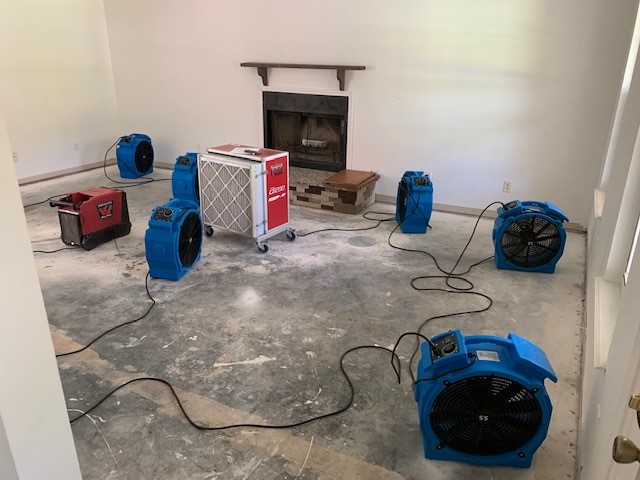
Once standing water and ruined materials are removed, the remaining framing, subflooring, and resilient materials are dried using a balanced combination of air movement and dehumidification:
-
Industrial Air Movers: These units deliver high-velocity airflow across wet surfaces, accelerating the rate of evaporation by breaking up the stagnant boundary layer of humid air directly above the material.
-
Low-Grain Refrigerant (LGR) Dehumidifiers: As air movers turn liquid water into water vapor, dehumidifiers pull that wet air in, rapidly cooling it to condense the moisture out of the air, and pumping out dry, pre-heated air capable of absorbing more moisture.
The Moisture Equilibrium Note: Simply turning on a residential HVAC system or standard household fans will not dry a building fast enough to prevent mold. Professional restoration relies on calculating grain depression—the reduction of moisture specific humidity in the air—to ensure that structural wood reaches an equilibrium moisture content (EMC) safe from decay.
Navigating Insurance and Recovery
Dealing with property damage is stressful, but structured documentation streamlines the path forward.
-
Document Everything: Before a single drop of water is removed, take extensive photographs and videos of all affected rooms, high-water marks, and damaged personal property.
-
Mitigate Further Damage: Property owners have a legal obligation under most insurance policies to take reasonable steps to prevent secondary damage. Shuttling standing water out or setting up immediate professional extraction fulfills this requirement.
-
Detailed Logging: Professional restoration technicians keep daily logs tracking moisture readings, temperature, and relative humidity. These logs provide concrete data required by insurance adjusters to validate the scope of the drying project and approve claims seamlessly.


Comments
Post a Comment